

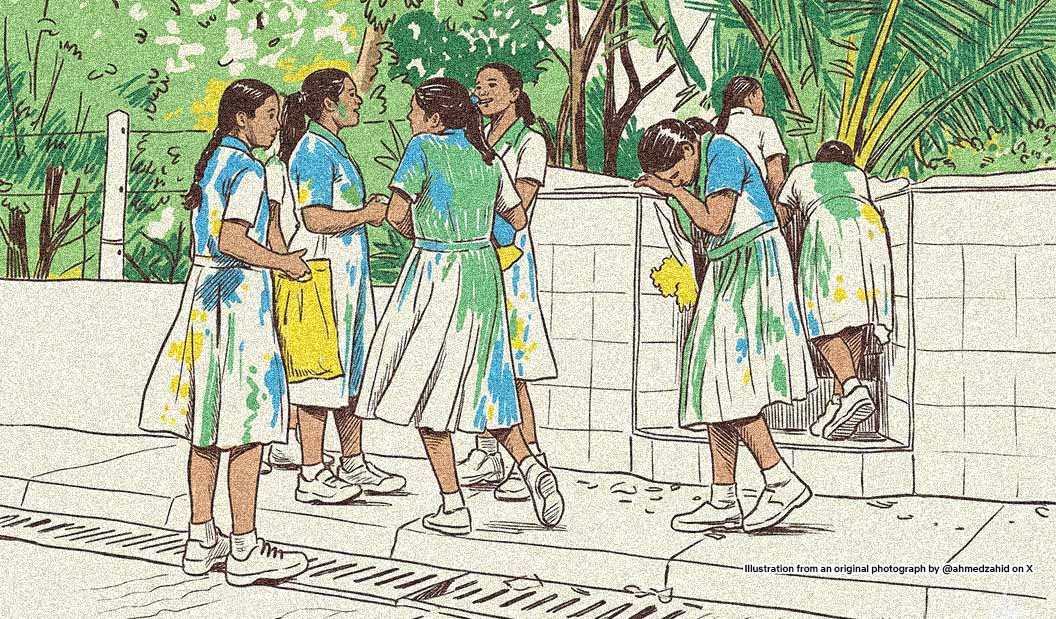
The government’s proposal to introduce a single four-color uniform for all schools has raised questions about cost, practicality, and the policing of girls’ attire. These debates are important, yet they point to a deeper assumption that deserves examination. Do we need to dress alike to be united? Does harmony come from similarity, or from learning to coexist with differences?
Policies can be well-meaning and still raise deeper questions about how we understand society, belonging, and identity. The concern here is philosophical: when we reach for uniformity as a solution, what assumptions are we making about what truly binds a nation together? What do we risk overlooking in the lived richness of our communities when we assume sameness is the path to solidarity, harmony, unity?
Schools in the Maldives already have uniforms – ones that are decent, accepted by parents and students alike, and generally comfortable. Their colors were chosen years ago and have come to carry meaning. A school’s palette, emblem, and motto reflect its history and culture. Students take pride in these identities and alumni still return to participate in events, mentor younger pupils, and support their old schools. I recall with fondness the pride my schoolmates had in pinning our verdant greens in tournaments, as Aminiyans. Former Majeediyans have been very enthusiastic in their preparations counting down to a proud century of existence. While the schools do not function under these names anymore, EPSS and MES, our rivals on all fortes, still have their active alumni associations doing community service and keeping their schools names and colors alive, even lamenting an erasure of their schools from the memory of the education system. We were competitors, but always with respect and admiration for one another. All our colors flew high together. This sense of attachment is not a threat to national unity but rather one of the ways individuals learn to belong to a community. Where schools have active past pupils’ associations we see enthusiastic engagement to celebrate milestones and a gathering of a community that brings together young and old in a spirit of belonging and camaraderie.
Supporters of a universal uniform suggest that it will reduce fragmentation and strengthen patriotism. Unity is a worthy goal, but it cannot be manufactured through visual sameness, it cannot be that superficial. History shows us that can be a very dangerous path to follow. National identity does not require the erasure of smaller identities. Healthy societies rely on layered belonging. One can be deeply connected to the country while also feeling loyalty to a school, an island, a profession, or a neighborhood.
Uniformity Vs Unity
Philosophers across eras have cautioned against the misconception of equating unity with uniformity.
John Stuart Mill argued that individuality is a primary engine of social progress. For Mill, variation is not an inconvenience to be flattened but a resource that drives learning and adaptation, and societies that encourage harmless differences tend to be more creative and resilient. Jean Jacques Rousseau recognized that communities need shared values, yet he also warned that excessive conformity can suppress authentic development. A well-functioning society, he suggested, is one that nurtures virtue and character, not one that tries to make its citizens identical. Alexis de Tocqueville observed that democracies face a constant temptation to promote sameness in the interest of equality. Yet he also noted that the vitality of a democratic nation depends on the freedom of associations, clubs, schools, and groups where people form smaller identities and loyalties. These micro communities strengthen the larger one. The point these philosophers arrive at is the same; we do not have to be identical to be a strong, resilient, prosperous, harmonious community or country. Are these not what we are striving for here?
Writers have made similar observations. George Orwell showed in his essays and novels how the push for sameness, even when framed as social good, can narrow thought and weaken the richness of human experience. Aldous Huxley warned that societies that become too standardized risk losing the very curiosity and individuality that sustain them.
While these might not seem like direct parallels to a school uniform policy, they are reminders that enforced similarity, even when well intentioned, has limits. It can create order, but not necessarily unity, and that is something we have to weigh deeply before rushing to hasty policy measures.
Let us posit a simple question. With dozens of schools across the country, interschool sports and academic tournaments depend on visual distinction. Teams need to be recognizable. Would these events also be reshaped in the pursuit of harmony, or does the need for individuality suddenly become valid in that context? If differences are acceptable in competition, why not in everyday learning environments?
A uniform serves several purposes, but so does the identity attached to it. School colors tell a story. They signal belonging. They help build confidence, pride, and continuity between generations. Removing these distinctions in the name of national unity assumes that smaller identities undermine larger ones. Yet most evidence suggests the opposite. People who feel grounded in a meaningful community, even a small one, are often more capable of contributing to a cohesive national life.
If the goal is to strengthen unity, there are more effective tools. Civic education, shared national practices, school cultures that promote respect for one another and social responsibility, and equitable access to opportunities do more to build a peaceful society than visual uniformity.
If the goal is discipline, again we are focusing on the wrong issue. We should be far, far more distressed to see littering near and within schools, students caught abusing animals, rampant bullying that goes unchecked, students who are nearing the end of their schooling years but who have not mastered the courtesy of giving way to a pregnant woman with a toddler in tow or an elderly person struggling to cross the street. We do not see programs that teach them to value our trees, our seas and all that live in and among those. We do not hear about kindness or empathy lessons, or exposure to struggles of a world they seem to be growing more and more detached from. We hear about standardized tests and quality control of schools, but what about the quality of their character by the time they step into the ‘real’ world? Should we not be more alarmed about students often resorting to rote learning to achieve higher marks, but failing to measure up in critical thinking, self -regulation, awareness of online safety and multitudes of other aspects that contribute far more to them being happy, healthy people in happy, healthy communities?
All of this brings us back to the central question. Must we enforce uniformity hoping for unity?



Leave a Reply